

A Paris Studio Market Ruled by Fashion
by Micaela Navarro, 28 July 2026
No surprise in the Paris studio data, but the scale of it is striking. Across the more than 50,000 requests processed through Eventflare, fashion work dominates the city's studio demand to a degree no other city matches. This is the demand-and-cost companion to the booking collection: it covers what gets shot here, where the studios cluster, what they list, what productions actually pay, and which spaces they return to. When you are ready to browse and shortlist, the full photo and film studios in Paris collection is the place to do it.
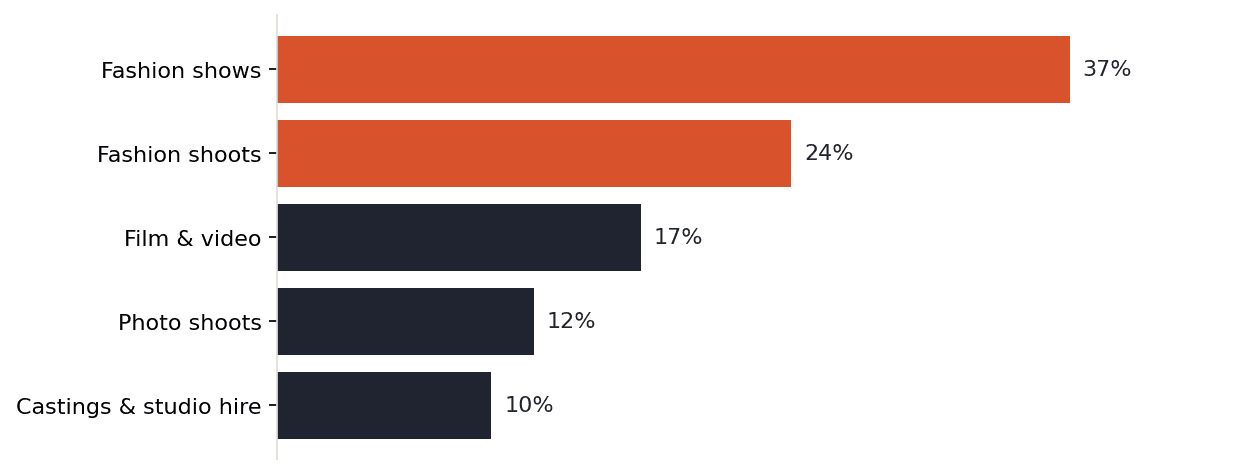
Fashion is six in ten studio bookings
Where the studios are
Eventflare lists 192 photo and film spaces across Paris, and they are not spread evenly. One arrondissement holds nearly a quarter of them.
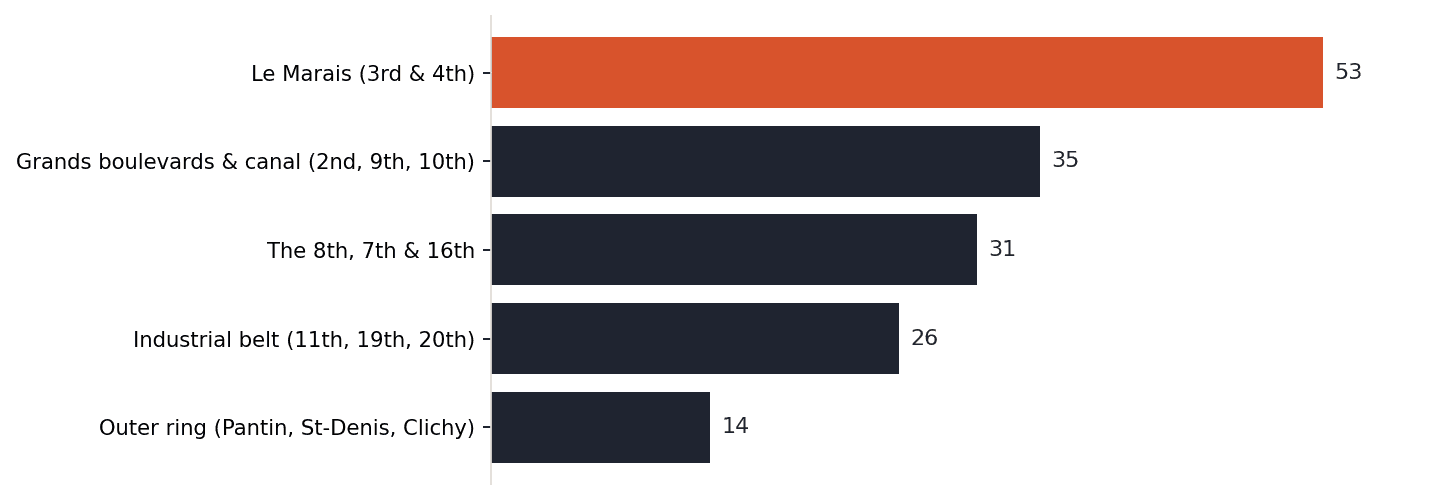
- Le Marais, the 3rd and 4th: 53 listings. The densest studio cluster in the city by a wide margin, with 45 in the 3rd alone. Galleries, vaulted cellars and stone-walled lofts behind medieval facades, the go-to for editorial and campaign work that wants texture without a set build. Load-in is the catch: narrow streets, courtyards, sometimes no lift.
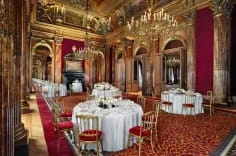
- The 8th, 7th and 16th: 31 listings. Neoclassical salons, mansions and marble halls with parquet, mouldings and chandeliers. Booked when the location itself is the styling, most often for fashion shows and luxury campaigns. Prices here run at the top of the range.
- The 2nd, 9th and 10th: 35 listings. The grands boulevards and the canal, converted banks and printing works. This is the practical middle: real character, real freight access, central addresses, mid-range rates.
- The 11th, 12th, 19th and 20th: 26 listings. The industrial belt of converted paper mills and warehouses with skylights and volume. Where the large fashion shows, film shoots and multi-day productions land, because these are the only central spaces with real floor area and street-level access.
- The outer ring, Pantin to Saint-Denis and Clichy: around 14 listings. Modern, industrial and comparatively affordable, with the easiest freight access anywhere in the region. The pragmatic choice when the budget matters more than the postcode.
Scale is concentrated too: 88 of the 192 studio spaces hold more than 100 people, 45 take over 200, and 20 handle more than 500, which is what makes full runway productions possible inside the city rather than out at a convention hall.
The pattern behind those clusters is simple. Central Paris sells character and punishes logistics, while the outer arrondissements sell space, power and access. Decide which one your shoot actually needs before you shortlist.
What a Paris studio costs
Studio pricing here runs hourly, and the spread is enormous. Across the 85 Paris studio listings that publish a rate, the median sits at €391 an hour, the middle half falls between €259 and €703, and the extremes run from €78 to over €7,000. The remaining 107 listings quote on request, which tells you something before you even ask: more than half of the city's studio supply prices itself case by case.
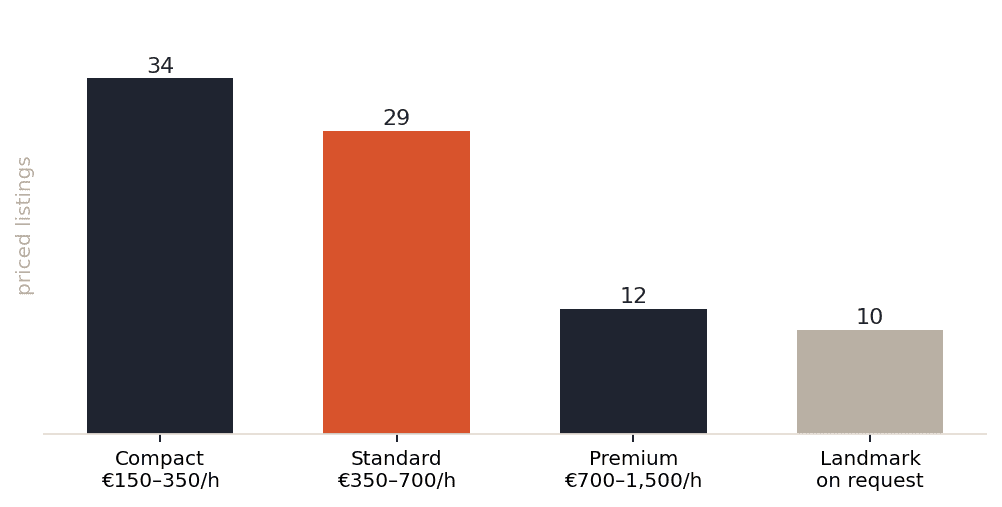
The table below is built from live listed rates, arranged by tier, and covers venue hire only. Equipment, crew, catering and cleaning sit on top.
| Tier | Listed rate | Typical capacity | What you get | Example |
| Compact | €150 to €350 per hour | 30 to 50 | Small lofts and apartment studios, daylight, minimal backstage. Lifestyle shoots, portraits, small crews. | Chic Parisian Loft at €162, Verdant Escape at €328 |
| Standard | €350 to €700 per hour | 45 to 180 | Converted lofts and industrial studios, skylights, hair and makeup stations, decent load-in. The workhorse tier for stills and video. | Cosy Industrial Loft at €338, Versatile Urban Haven at €473, Industrial Studio at €594, Expansive White Loft at €656 |
| Premium | €700 to €1,500 per hour | 80 to 150 | Design-led lofts and view spaces with strong art direction value. Campaigns, fashion shoots, brand content. | Stunning Loft with vaulted cellar at €1,250, Spiral Staircase Loft at €1,406 |
| Landmark | Priced on request | 250 to 1,500 | Marble halls, neoclassical ballrooms, large industrial halls. Fashion shows, runway productions and events combined. | Majestic Marble Hall, and comparable neoclassical ballrooms |
Four practical notes on that table. First, more than half the market quotes on request, so a shortlist built only from published prices is a shortlist of half the city. Second, hourly rates rarely multiply cleanly into day rates, since most studios discount full days and multi-day bookings, so always ask for the day rate rather than doing the arithmetic yourself. Third, a landmark venue's silence on price is a scheduling signal as much as a pricing one. And fourth, the tier you need is set by crew size and gear, since the look is available at every tier in this city.
What productions actually pay
Listed rates are what a studio asks. Booking data is what a shoot day costs once everything lands, and the two are different conversations.
Based on Eventflare booking data, filming bookings see an average venue line of around €760, with most falling between €415 and €1,500. Read that against the €391 median hourly rate on the listings and the picture resolves: most shoots buy two to four hours, not a day, and the rack rate is a ceiling almost nobody pays.
Two consequences follow. First, ask for the block, not the hour. A four-hour morning block at a standard-tier studio lands close to the average, while quoting eight hours because the rate card is hourly is how a €760 booking becomes a €4,800 one. Second, budget the crew, not the room, because staffing costs run high on shoot days when crews are small and specialist, and the room is the cheapest part of a production day in this city.
For the shoots that turn into events, and in Paris they often do, the numbers shift. Across Paris product launches, Eventflare data shows an average venue cost of €38 per guest, with catering at €29 and staff at €9. A fashion show that ends in a reception is two budgets, and the second one is not small.
Ten studios the data keeps surfacing
The workhorses
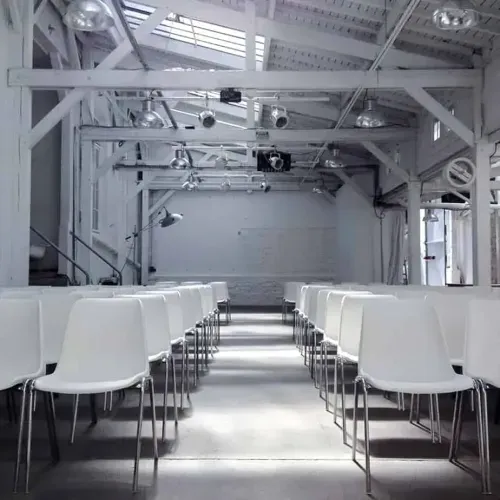
The Industrial Studio with a skylight is the space most productions default to, and the reason is arithmetic. At 475 square metres under a continuous glass roof, it delivers the two things Paris rarely offers together: uninterrupted floor area and unbroken north light. White steel beams and raw brick give art directors a backdrop that reads as deliberate rather than neutral, so a fashion show, a casting and a product shoot can run in the same hire without redressing. It stands out because it removes the usual Paris compromise between light and volume.
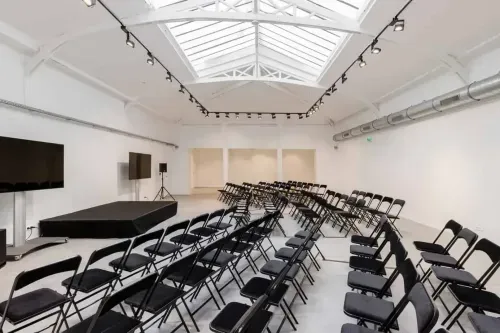
The Expansive White Loft with skylit ceilings is what people picture when they say studio: 270 square metres of white walls, polished floor and skylit ceilings, holding up to 180. Where the industrial spaces sell texture, this one sells absence, the closest thing central Paris has to a purpose-built cyclorama that still runs on daylight. That blankness is the point. Brands who need the product, not the room, to be the subject book here. It stands out as the city's cleanest daylight canvas.
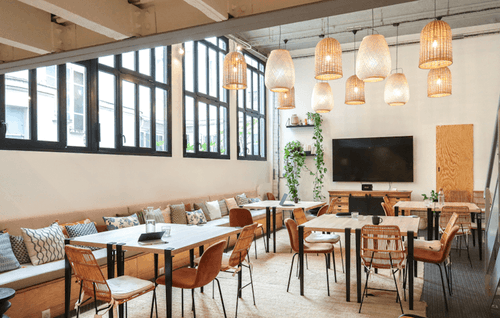
The Cosy Industrial Loft with rustic touches is a former printing workshop with a mezzanine and tall factory windows, holding around 45. What earns it repeat bookings is scale discipline: it photographs like a full studio while pricing and staffing like a small one, and the mezzanine doubles as a hair, makeup and client viewing area without eating into the shooting floor. It stands out because for a crew of eight with a half-day of stills, nothing in the city works harder.
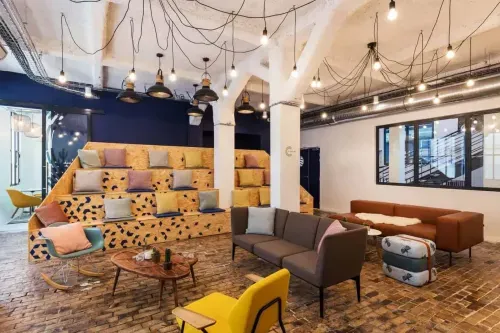
The Versatile Urban Haven with eclectic chic decor, once a blind factory, takes eighty people across an interior that mixes industrial bones with contemporary finishes and an eclectic, layered decor. It stands out for its range: enough character to shoot against, enough neutrality to light for video, and enough room to move a crew and a client group in the same space. Productions that need a set and a room for the client to sit in book this one.
The character sets
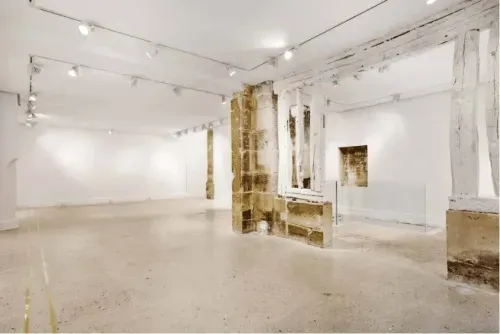
The Stunning Loft with a vaulted cellar, in the Marais, is two locations stacked on one address. Upstairs, a minimalist gallery with white walls and stone detailing; downstairs, a vaulted medieval cellar whose ceiling curves cannot be built on any soundstage. Campaign teams book it because a single day yields two distinct visual worlds, and the stone reads as genuinely old on camera in a way set dressing never quite manages. It stands out for giving two shoots one load-in.
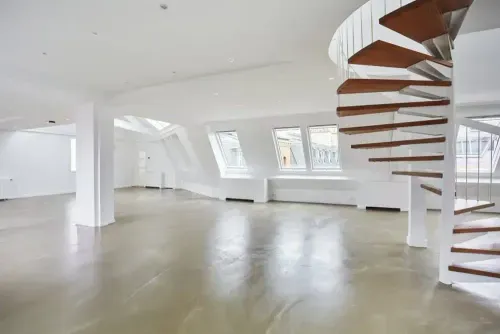
The Stunning Spiral Staircase Loft with Eiffel Tower views sells one thing and sells it completely. A sculptural spiral staircase anchors a loft with Eiffel Tower sightlines, giving art directors a hero shot and a location badge in the same frame. It sits at the top of the hourly range for good reason: this is a room booked when the image needs to say Paris without a caption. It stands out because no production budget recreates that staircase elsewhere.
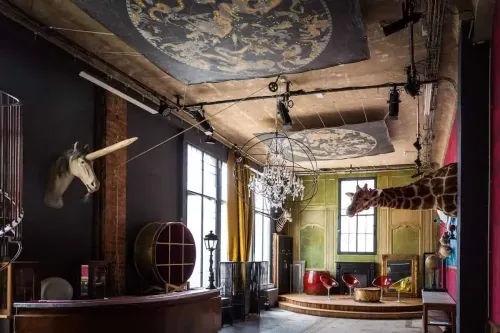
The Whimsical Baroque-Style Venue with eclectic charm is the outlier of the group, a baroque-meets-industrial world of ornament, colour and deliberate excess. Its value is the impossibility of faking it. A build team could approximate the props, but not the accumulated eccentricity, which is exactly what editorial and music-video work comes looking for when a clean studio would flatten the concept. It stands out as the set you cannot construct on a schedule.
Small crews and big shows
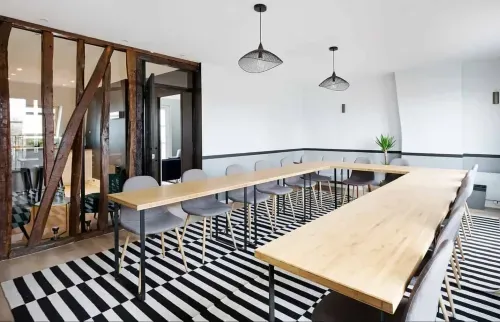
The Chic Parisian Loft with picturesque views is the most accessible rate on this list and the easiest booking in the category. It holds thirty, runs on daylight through picturesque Parisian windows, and suits casting days, portrait sessions and lifestyle shoots where a crew of four is the entire operation. It stands out as the proof that a Paris shoot does not require a Paris budget.
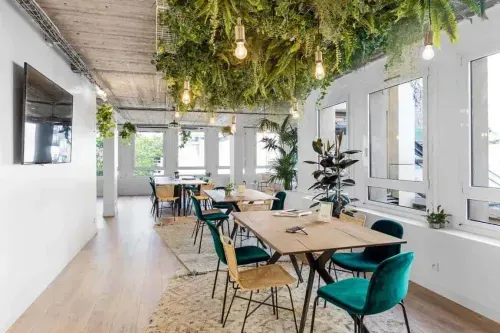
The Verdant Escape with Eiffel Tower views trades studio neutrality for greenery, holding around fifty guests among planting with a tower sightline behind it. What makes it unusual is that the set arrives pre-dressed: lifestyle, wellness and food shoots that would otherwise pay for a day of styling get their environment for free, and the same space converts to a shoot-day reception without a reset. It stands out because the styling is built into the room.
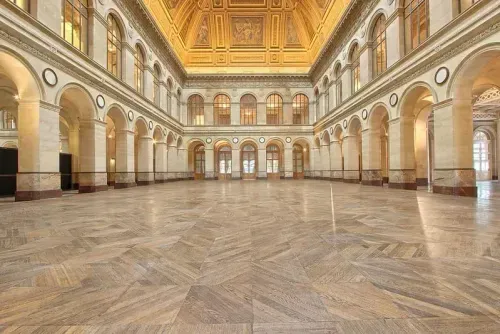
And at the far end of the market, the Majestic Marble Hall with 19th-century splendor is where Paris runs actual runway productions. Marble, parquet, 19th-century proportions and a capacity reaching 1,500 mean a fashion show, its backstage, its audience and its after-reception all fit under one roof. It stands out because at this scale, most cities force you to split the show across venues, and here you do not have to.
Booking around the fashion calendar
If your shoot is not fashion, the fashion calendar is still your problem: during the main fashion weeks, availability collapses and rates firm for everyone. The demand data shows the twin peaks plainly, with March taking the largest single share of the year and September and October close behind, the windows around Paris Fashion Week when the studios, crews and equipment tighten together.
The inverse is the opportunity. Outside those windows, and especially in the winter lull of January and February, studios negotiate on multi-day hires because their event-side business is quiet. August is the other soft spot, though crew availability thins with it. Book against the peaks rather than into them, and the same room costs less and gives more.
The brief that saves a day rate
Three technical points settle most Paris studio negotiations. Load-in: Haussmannian buildings are beautiful and hostile to freight, so confirm street-level doors or a lift before you fall for a space. Power and blackout: motion work needs both verified, not assumed. And both-format intent: tell the studio up front if you are shooting stills and video, because sound treatment and neighbour policies differ, and finding out mid-shoot is expensive.
Start from the photo and film studios in Paris collection, book against the fashion calendar rather than into it, match the tier to your crew rather than your mood board, and lock the technical rider before the deposit.


Related articles
 What Paris Afterwork Rates and Demand Look Like in 2026
The Paris afterwork has two secrets. Across the more than 50,000 requests processed through Eventflare, cocktail
 Inside the Paris Conference Market in 2026
Paris runs on the classic conference. Based on 50,000+ requests processed through Eventflare (till June 2026), straight
 Paris Outdoor Events Are Built for Business in 2026
Paris does not book outdoor space for parties. It books it for business. Based on 50,000+ requests processed through
 Everything You Need to Know About Paris Meeting Rates and Demand in 2026
The Paris meeting market has a tell. Across the more than 50,000 requests processed through Eventflare, client meetings
 Corporate Event Venues in Paris: What the Full Demand Picture Shows
Corporate events are the biggest single slice of the Paris market and the clearest window into how the city is used.
 Paris Is Europe's Deepest Event Market in 2026
Paris is the deepest event market Eventflare tracks, with 872 published venues spanning Haussmann salons, Seine barges,
 7 Luxurious Reception Halls in Paris for High-End Corporate Events
Paris has long been the stage for moments of prestige, where history and modernity meet to create settings unlike
 Paris's Finest Private Dining Rooms Near Palais des Congrès
As IMCAS 2026 approaches, Paris is preparing to welcome thousands of delegates to the Palais des Congrès in the 17th
 Where to Host a High-Society Dinner During IMCAS 2026
As the world of aesthetic medicine comes together in Paris for IMCAS 2026, the congress days will be filled with
 Top Paris Banquet Halls for High-Impact Medical Industry Dinners
As anticipation builds for IMCAS 2026 in Paris, the global hub of aesthetic medicine will once again draw thousands of
 Paris’s Historic Venues: Tradition Meets Modern Sophistication
Romance, designer brands, and the most flaky croissants you have ever tasted may be the Paris we know today, but the
 5 High-End Private Dining Rooms in Paris
Croissants and coffee may be breakfast favourites everywhere, but they're quintessentially French, offering a glimpse
Get access to the event industry's inside scoop