

Paris Event Venues: What Eventflare Demand Data Tells Us
by Micaela Navarro, 08 July 2026
Paris is one of the most active corporate event markets in Europe, and the way companies book venues here has clear, repeatable patterns. This article looks at what the demand actually shows in the Eventflare data, drawn from thousands of real venue requests and confirmed bookings in the city. The goal is to give planners, marketers and event owners a clear read on how Paris behaves, so you can make better decisions about timing, format and space.
With more than 850 venues across Paris and the Île-de-France, the choice is enormous. Browse the full range of event venues in Paris as you read.
The Paris event calendar is sharply seasonal
The first thing the data makes obvious is that Paris does not spread its events evenly across the year. Demand concentrates in two windows, and it concentrates hard.
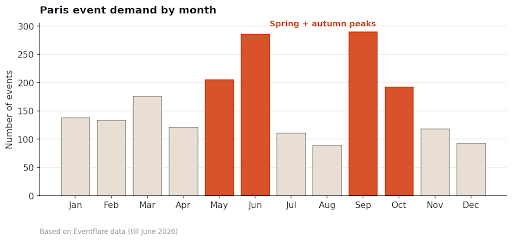
Spring, particularly May and June, is one peak. The other is autumn, September and October, and September in particular stands out. As the chart shows, September drew close to three times the volume of the quietest winter months, with June close behind.
The quiet periods are just as clear. July and August drop off as the city empties for the summer holidays. November and December soften too, apart from the year-end party season, which is more compressed and concentrated in December than the spread you see in spring.
The practical takeaway is direct. If your event has to happen in May, June or September, you are competing with the largest share of the market for the same rooms on the same dates. Book early, or expect a shorter list of available venues and firmer pricing. If your date is flexible, the shoulder months of March, April and late October can give you more choice and more room to negotiate, while still landing in decent weather.
Cocktail parties and celebrations dominate the format mix
When you look at what companies are actually hosting in Paris, a small number of formats account for a large share of activity.
Cocktail parties lead. This is the single most requested corporate format in the city, and it is not close. Celebrations of various kinds come next, followed by general event-venue bookings where the client wants a flexible space rather than a fixed format. Networking evenings, after-work gatherings and award ceremonies also feature heavily.
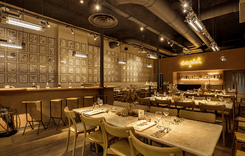
There is a clear logic behind the popularity of the cocktail format. It scales from a few dozen guests to several hundred without changing the fundamental setup. It works in almost any venue that has a bar and standing room, like the Industrial-Chic Restobar for Networking Cocktail Hours shown above. It carries lower production demands than a seated dinner or a staged conference, which keeps budgets manageable. And it delivers the thing most corporate hosts actually want from a Paris evening, which is atmosphere and the chance for guests to talk.
Seated dinners, business dinners and private dining form a distinct second cluster. These events are usually smaller and higher-value per head, and they point to a different venue need: restaurants and private dining rooms with a strong kitchen, rather than large flexible halls. A real example from our bookings shows the range. Hack The Box hosted a 28-person business dinner, while at the other end, Jane Street ran a 500-person celebration. Both are corporate events in Paris, and they need completely different rooms. Browse private dining rooms in Paris for the smaller end.
Conferences, seminars and summits make up a third meaningful category, which is significant enough to deserve its own strategy. That category has its own venue logic around auditoriums and staged spaces, covered in our guide to conference venues in Paris.
Venue character is a deciding factor
One of the strongest signals in Paris demand is how much clients value the character of the room itself. The most requested venues in the city are not neutral boxes. They are spaces with a distinct personality: a glass boat on the Seine, a brutalist hall lit by a skylight, a rooftop with Haussmann-era styling, a dramatic art deco dining hall.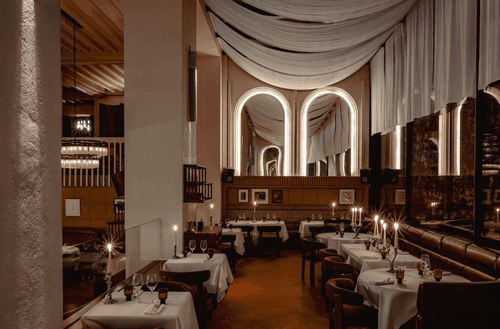
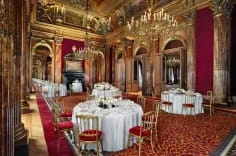
This matters because it tells you where budget is best spent. In Paris, a venue that arrives with atmosphere already built in, like the Dramatic Art Deco Dining Hall With Draped Arches above, saves you money on production and decoration, and it usually looks more convincing than a blank space you have dressed for a day. For most corporate events here, the room is doing a large part of the work, and clients recognise that when they choose.
There is a limit to this, and it is worth naming. For launches and shoots, the opposite is true: brands often want a neutral shell like a light-filled gallery so they can install their own world for a day. And for conferences and large staged events, function has to win over character. A gorgeous salon with a flat floor and poor acoustics is the wrong choice for 200 people watching a keynote, no matter how good it looks. The venues that succeed for those events are the ones built for the job, and clients who try to force a mismatch usually spend more fixing it than they would have on the right room.
Guest count is the real filter
If there is one number that shapes a Paris venue search more than any other, it is the guest count. The city has an enormous supply of venues for small and mid-sized groups, roughly up to 150 people. Above that, the list thins quickly, and above 300 it thins dramatically.
This is why large events in Paris cluster around a specific set of spaces. Converted industrial halls, dedicated event spaces and a handful of grand ballrooms are the venues that genuinely hold 300 to 500 guests, and they are often a little outside the historic core where floor plates are bigger. Euroclear's 300-person corporate event landed in a classic ballroom. Jane Street's 500-person celebration went to a large event space with the floor area to match. Neither could have happened in the charming 60-person loft that suits a product launch.
For planners, the lesson is to lead with the guest count when you start looking. It removes the venues that cannot physically work before you fall in love with one of them. The larger your group, the earlier this filtering has to happen, because the pool of options is smaller and those options book out first.
Budgets track format and headcount, not prestige alone
The spend data reinforces a point that is easy to miss. Cost in Paris follows what an event actually requires, not simply how fancy the venue sounds.
A large formal event with full catering for 300 guests runs into six figures, as Euroclear's booking shows. A purpose-built conference for 250 with the audiovisual infrastructure it needs sits in the same territory. Meanwhile, a carefully chosen dinner for 30 key clients can cost more per head than a reception for 200, because the value is in the food, the service and the exclusivity rather than the floor area.
As a rough guide, a 150-person salon in the prestigious 8th arrondissement rarely starts below €5,000 for the day, while an industrial space of equivalent capacity in the 13th or 19th can run 30 to 50 percent cheaper. None of these is expensive or cheap in the abstract. Each is priced for what it delivers. The most useful thing a planner can do is define the format and the headcount first, then look at venues that fit both, because that is what determines the budget far more than the postcode.
What this means for planning your Paris event
Pulling the threads together, a few clear rules emerge from the Paris demand.
- Time your event with the calendar in mind. May, June and September are the busiest and tightest windows. If you can move to a shoulder month, you gain choice and negotiating room. If you cannot, book well ahead.
- Choose the format honestly, then let it choose the venue. A cocktail party, a seated dinner and a conference need fundamentally different rooms. Most Paris disappointments come from picking a space for its looks and then discovering it fights the format.
- Lead with guest count. It is the fastest way to cut a huge venue list down to the spaces that can actually work, and it matters more the larger your group.
- Lean on venue character where you can. Paris rewards clients who pick spaces with built-in atmosphere, because you spend less making them look good. Save the blank-canvas approach for launches and shoots that genuinely need a neutral shell.
Paris will host almost any event well. The city's depth is its strength and, for a first-time planner, its challenge. Start from your date, your format and your guest count, and the right kind of venue becomes much easier to find. Begin your search across all Paris event venues.


Related articles
 Corporate Event Venues in Paris: What the Full...
Corporate events are the biggest single slice of the Paris market and the clearest window into how the city is used. Drawn from the more than 50,000 requests processed through
 7 Luxurious Reception Halls in Paris for...
Paris has long been the stage for moments of prestige, where history and modernity meet to create settings unlike anywhere else in the world. Within its grand boulevards and
 Paris's Finest Private Dining Rooms Near...
As IMCAS 2026 approaches, Paris is preparing to welcome thousands of delegates to the Palais des Congrès in the 17th arrondissement. Beyond the lectures and conferences, the city
 Where to Host a High-Society Dinner During...
As the world of aesthetic medicine comes together in Paris for IMCAS 2026, the congress days will be filled with innovation and expertise. But it is in the evenings that Paris
 Top Paris Banquet Halls for High-Impact...
As anticipation builds for IMCAS 2026 in Paris, the global hub of aesthetic medicine will once again draw thousands of distinguished professionals seeking inspiration, innovation,
 Paris’s Historic Venues: Tradition Meets...
Romance, designer brands, and the most flaky croissants you have ever tasted may be the Paris we know today, but the French capital has a rich history that continues to influence
 5 High-End Private Dining Rooms in Paris
Croissants and coffee may be breakfast favourites everywhere, but they're quintessentially French, offering a glimpse of the food scene in Paris. The City of Lights has a way of
 The 4 Most Exclusive Cocktail Reception Venues...
The soft clink of crystal glasses resonating under the glow of antique chandeliers in a refined Parisian salon, or the pleasure of savouring signature cocktails on a rooftop
 6 Exclusive Cocktail Reception Venues in Paris
When you're looking to hire event venues in Paris for a cocktail party, there's one key rule every event planner should bear in mind: hosting a cocktail party in Paris isn't just
 Best Coworking Spaces in Paris
Paris, the city of lights, romance, and endless inspiration, isn’t just for tourists and dreamers—it's also a haven for digital nomads, freelancers, and entrepreneurs. Imagine
 The Coolest and Quirkiest Alternative Venues...
Paris—the epitome of class, charm, and timeless elegance. Known as the City of Lights and Love, it enchants with its historical landmarks and iconic style. But beneath its
 Discover Paris’ Most Collaborative Workspaces
The French may be known for their fashionable, laid-back lifestyle, but Paris is up to the mark when it comes to collaboration.The iconic Eiffel Tower, an engineering marvel and
Get access to the event industry's inside scoop